How to Choose the Right Light Pole for Your Next Project: A Comprehensive Guide
Selecting the appropriate light pole is a critical decision that impacts the safety, aesthetics, durability, and long-term cost of any lighting project. Whether you're planning a new street light pole installation for a municipal road, a decorative light pole for a tourism district, or a robust high mast for a port facility, the wrong choice can lead to premature failure, safety hazards, and inflated maintenance budgets. With the global push towards smart city infrastructure and sustainable energy, options like the smart light pole and solar light pole are becoming increasingly relevant. This guide will walk you through the key considerations, helping you make an informed decision that aligns with your project's specific needs.
1. Define Your Project's Core Requirements
Before diving into materials and styles, clearly outline your project's fundamental parameters.
- Application & Environment: Is this for a coastal roadway (high corrosion), a city park (aesthetics), an industrial yard (heavy-duty), or a highway interchange (high wind load)? The environment dictates the required material and protective finishes.
- Height & Lighting Class: Standard street light poles typically range from 6 to 12 meters. High mast lighting for large areas like stadiums or container yards can exceed 30 meters. The height directly influences structural design and base requirements.
- Mounting Type: Will the pole be direct burial (a simple, cost-effective method for lighter poles) or installed with an anchor bolt foundation system (required for taller, heavier poles like steel light pole variants)?
- Regulatory Compliance: Which design standards must be met? Common standards include American AASHTO, ANSI AISC, and European EN40 series. Compliance is non-negotiable for safety and liability.
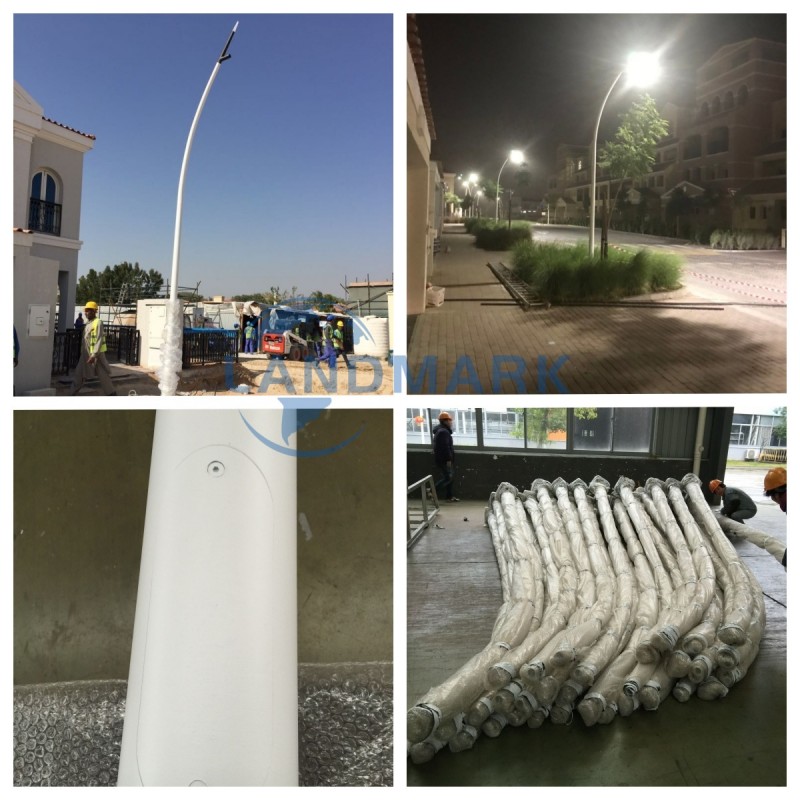
A sleek aluminium light pole offering a modern aesthetic and corrosion resistance for urban landscapes.
2. Material Selection: Aluminium, Steel, or Stainless Steel?
The choice of material is paramount for performance and lifespan.
Aluminium Light Poles
Advantages: Naturally corrosion-resistant, lightweight (reducing shipping and installation costs), requires no painting (maintains appearance with anodic oxidation), and is 100% recyclable. Ideal for coastal areas, decorative applications, and solar light pole systems where weight matters.
Considerations: Generally higher material cost than galvanized steel, and while strong, may not be the first choice for extreme height or load requirements without specific alloy and design.
Galvanized Steel Light Poles
Advantages: High strength-to-cost ratio, excellent for tall and heavy-duty applications like high mast and robust street light poles. Hot-dip galvanizing provides a thick, durable zinc coating for corrosion protection.
Considerations: Heavier than aluminium, increasing logistics costs. The galvanized finish is functional but may not offer the aesthetic flexibility of powder-coated aluminium. Requires periodic inspection in highly corrosive environments.
Stainless Steel Light Poles
Advantages: Superior corrosion resistance, especially in chemical or marine environments. Offers a distinctive, modern appearance with high structural integrity. Often used for prestigious projects and specific decorative light pole designs.
Considerations: The highest material cost among the three. Can be subject to surface staining if lower grades are used in harsh environments.
Companies like LANDMARK (Guangdong Landmark Technology Co., Ltd.) specialize in all three materials, allowing for unbiased recommendations based on your project's technical and budgetary needs. Their expertise in aluminium light pole and steel light pole manufacturing, backed by Ph.D.-level structural design, ensures the optimal material is selected and correctly engineered.
3. Corrosion Protection: The Key to Longevity
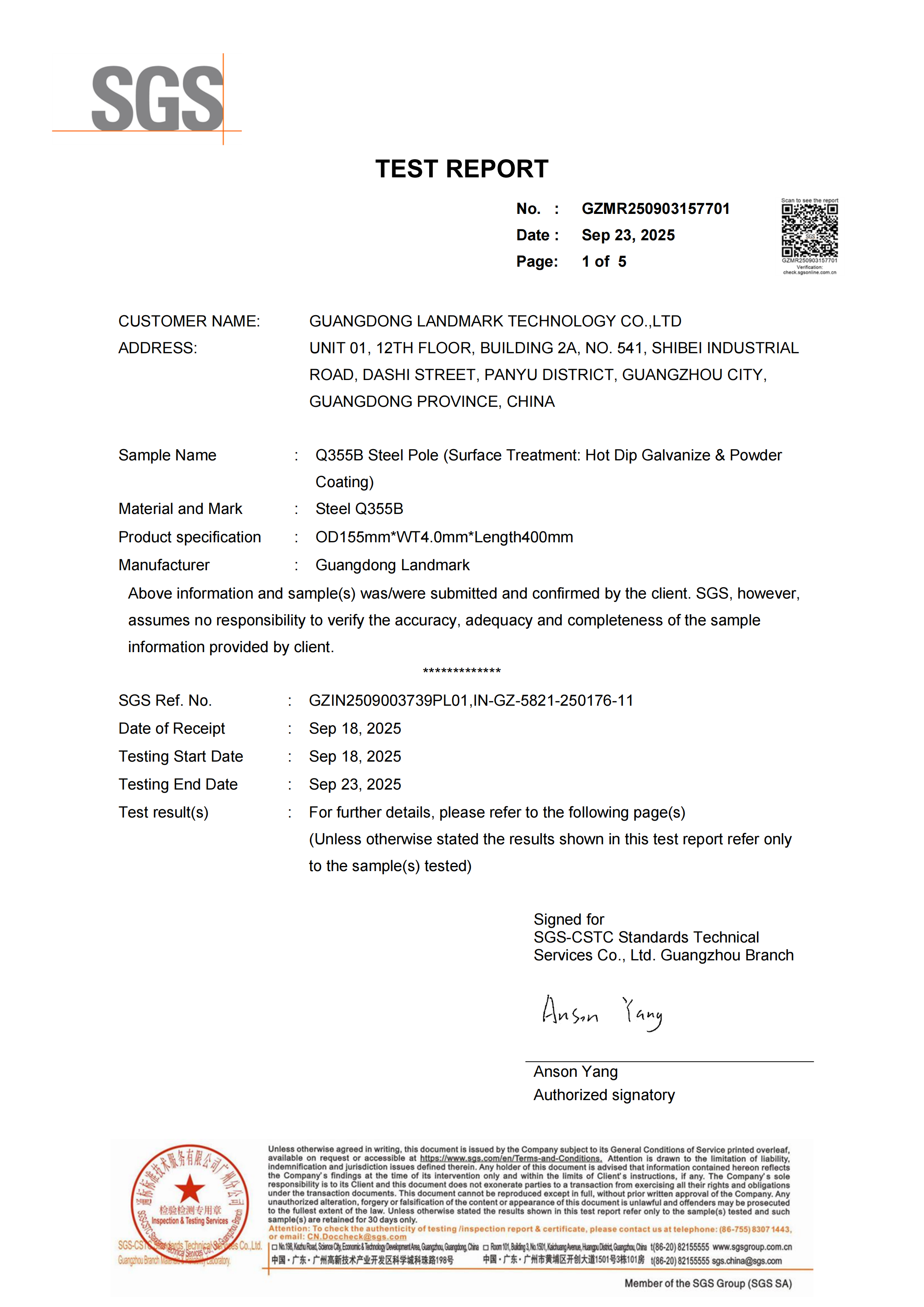
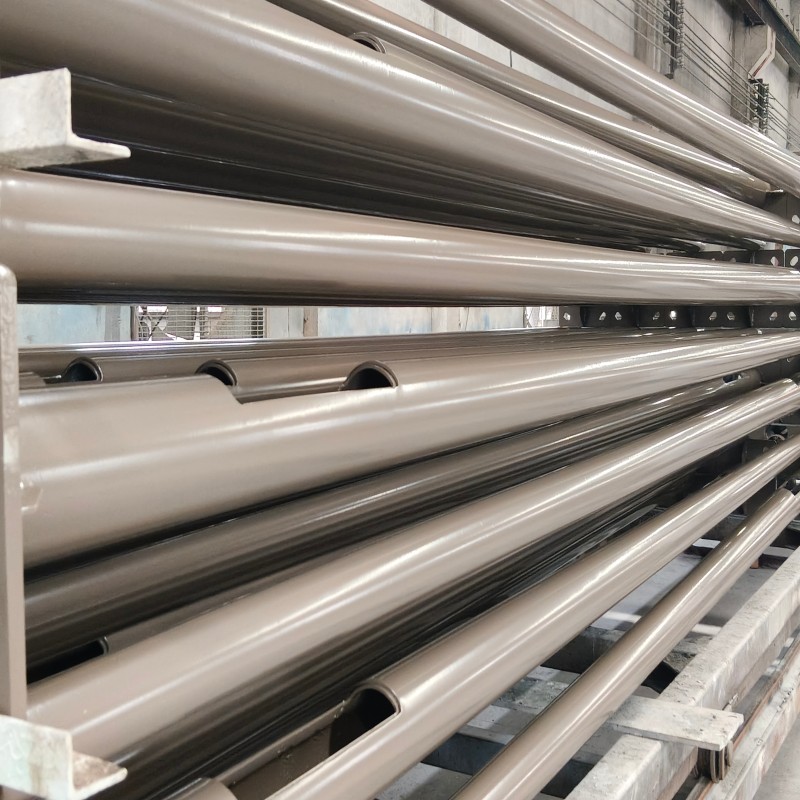
A pole's material is only as good as its protection. For steel light poles, hot-dip galvanizing (HDG) is the baseline. The real test is in the details: weld quality, coating thickness, and supplementary finishes. For extreme environments, a combination of HDG and a high-quality powder coat is essential.
LANDMARK's corrosion protection team provides solutions for marine, oil & gas, and mining sectors. Their rigorous testing, as evidenced by certifications like the "Salt Spray Test of Steel Pole Powder Coat Finish" and "Hot Dip Galvanized Coating Test Report", guarantees performance. For aluminium light pole products, they ensure proper alloy selection (e.g., 6063, certified for material composition) and anodic oxidation processes.
4. Specialized Pole Types and Modern Trends
- Solar Light Pole: An integrated off-grid lighting solution. Key factors include battery capacity, panel wattage, and the pole's ability to support the panel weight and withstand weather. Lightweight aluminium light pole designs are often preferred.
- Smart Light Pole: The backbone of smart cities, integrating cameras, sensors, EV chargers, and Wi-Fi. Requires internal conduit space, structural capacity for added devices, and often a direct burial aluminium light pole or foundation design that facilitates cable management.
- Decorative Light Pole & Flagpole: Aesthetics are paramount. Custom shapes, finishes, and ornamental elements are common. A tall flagpole for a civic center requires precise engineering for wind-induced oscillation, while a decorative light pole for a plaza focuses on design integration.
- High Mast: Used for large-area illumination. Critical factors include the raising/lowering system reliability, wind load calculations, and foundation design. Typically constructed from high-strength steel light pole sections.
5. The Importance of Manufacturer Capability and Certification
Your supplier's expertise is as crucial as the product specs. Look for:
- In-house Engineering: Can they perform structural design and verification per international standards? LANDMARK has a team mastering EN40, AASHTO, and ANSI standards.
- Full-process Quality Control: From material certification ("Material Composition Certificate of Aluminium 6063") to welding tests ("Magnetic Testing Report for Steel Pole Welding", "Welding Dye Penetrant Testing Report") and final inspection. An ISO-certified system (like LANDMARK's ISO certificate) is a strong indicator.
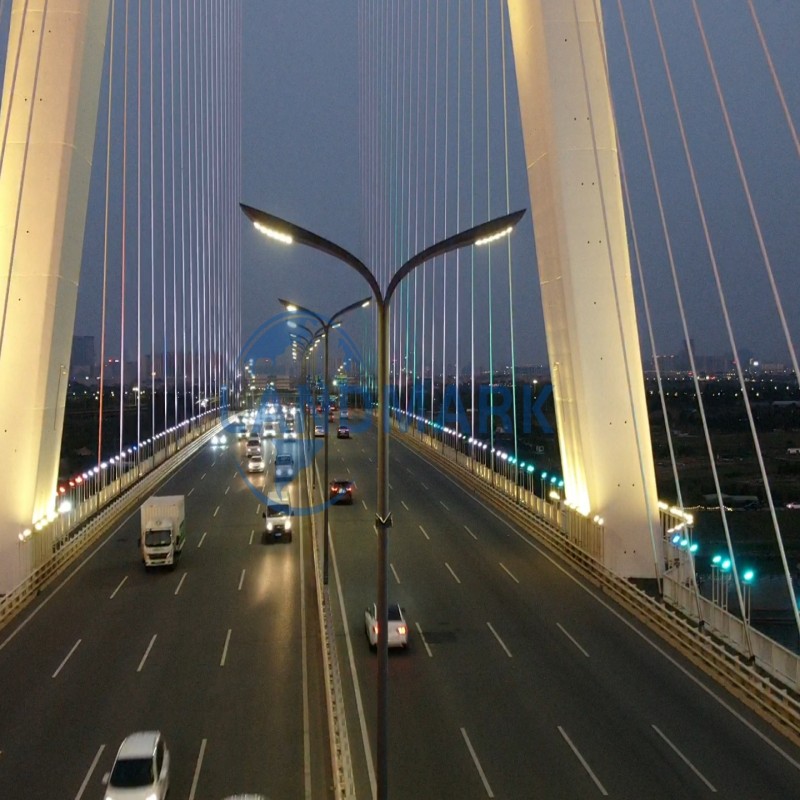
- Customization & Project Experience: Have they delivered for large-scale events, municipal projects, or landmark buildings? This proves they can handle complex, customized orders.
- International Market Access: Certifications and approvals for markets like the UAE, USA, Australia, etc., demonstrate a commitment to global quality benchmarks.
Conclusion: Partnering for Success
Choosing the right light pole is a technical procurement decision. By systematically assessing your application, environment, material needs, and supplier credentials, you can ensure a successful, long-lasting installation. Partnering with an integrated manufacturer like Guangdong Landmark Technology Co., Ltd. (LANDMARK) provides a significant advantage. Their closed-loop system—from R&D and design using advanced standards to production, quality control, and after-sales support—ensures you get a pole that is not just a product, but a engineered solution. Whether you need a standard street light pole, a corrosion-resistant direct burial aluminium light pole, or a futuristic smart light pole, their expertise across aluminium, stainless steel, and galvanized steel poles positions them as a reliable global partner for your next project.
For a detailed consultation tailored to your specific requirements, contact the LANDMARK team today.
Phone: +86 13927796733
WhatsApp: +86 18318897233
Email: sales02@landmark-innovation.com
Website: www.landmark-innovation.com