The Procurement Professional's Guide to Selecting Specialized Light Pole Suppliers for Demanding Applications
For procurement professionals in infrastructure, construction, and municipal development, selecting a light pole supplier is more than just buying a product; it's sourcing a critical, long-term structural component. Standard poles may suffice for simple applications, but projects in harsh environments or with unique requirements demand specialized suppliers. This guide provides a framework for identifying and partnering with manufacturers capable of delivering beyond the generic, focusing on the unique demands of modern infrastructure.
1. Understanding Industry-Specific Demands for Light Poles
The core requirements for light poles vary drastically by application. A supplier must understand these nuances to provide a safe and durable solution.
- Coastal & Marine Environments: Salt spray is highly corrosive. Poles require advanced protection systems like hot-dip galvanizing to ASTM A123 standards, specialized marine-grade powder coatings, or the use of inherently corrosion-resistant materials like aluminium alloy 6063 or 316 stainless steel.
- Industrial & Chemical Zones: Exposure to chemical pollutants, acidic fumes, or abrasive particulates necessitates robust, chemically resistant finishes and sealed designs to prevent internal corrosion.
- High-Wind & Seismic Regions: Structural integrity is paramount. Poles must be engineered to specific wind load maps (e.g., ASCE 7, EN 1991-1-4) and seismic codes. This requires sophisticated structural analysis, not just basic calculations.
- Smart City & Communication Hubs: Smart light poles act as multi-functional platforms. Suppliers must integrate design for antenna mounts, cable management, access panels, and thermal management for electronic equipment without compromising structural strength.
- Architectural & Landmark Projects: Here, aesthetics are as critical as function. Suppliers need custom decorative light pole design capabilities, offering a range of finishes, shapes, and ornamental elements that reflect local culture or brand identity.
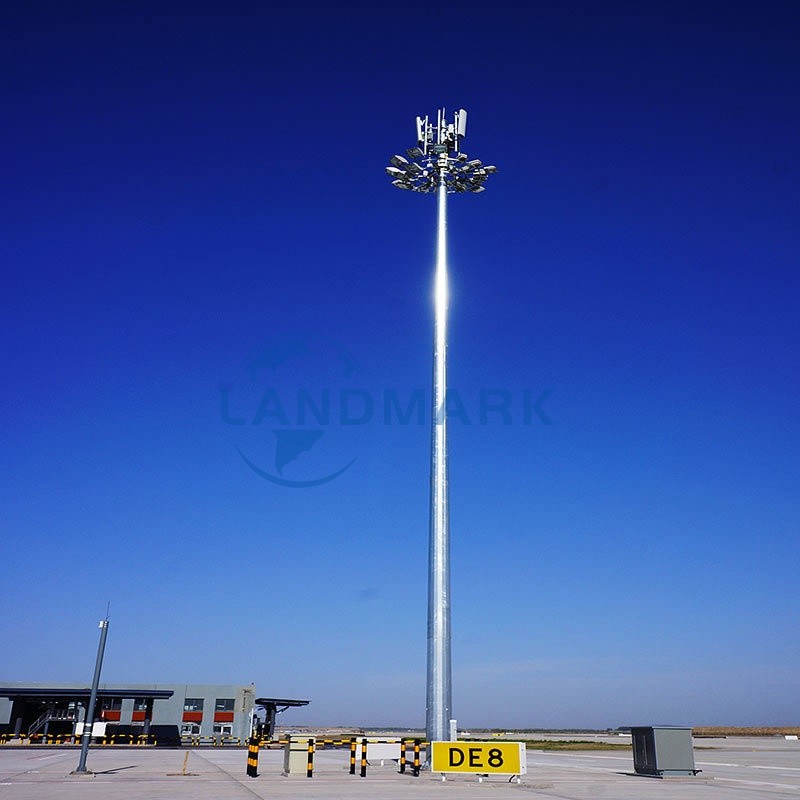
High masts for industrial yards require rigorous engineering for wind loads and corrosion resistance.
2. The 3 Essential Capabilities of a Specialized Supplier
When vetting suppliers, move beyond basic manufacturing. Look for these three non-negotiable competencies.
1. Proven Industry Customization Experience
A true partner has a portfolio demonstrating adaptation to specific challenges. For instance, Guangdong Landmark Technology Co., Ltd. (LANDMARK) leverages its team of Ph.D. and Master engineers to master standards like European EN40-5/6/7 and American AASHTO. They don't just sell poles; they provide structural design and verification services for contractors, a critical value-add for complex projects like high mast installations for ports or stadiums.
2. Comprehensive Compliance and Certification
Certifications are objective proof of capability. Insist on seeing:
- Material Certificates: Mill test reports for aluminum (e.g., 6063) and steel.
- Corrosion Test Reports: Salt spray test results (e.g., ASTM B117) validating coating longevity.
- Welding Certifications: CWB (Canadian Welding Bureau) or equivalent certifies weld procedure and personnel qualification.
- Quality Management: ISO 9001 certification ensures consistent processes.
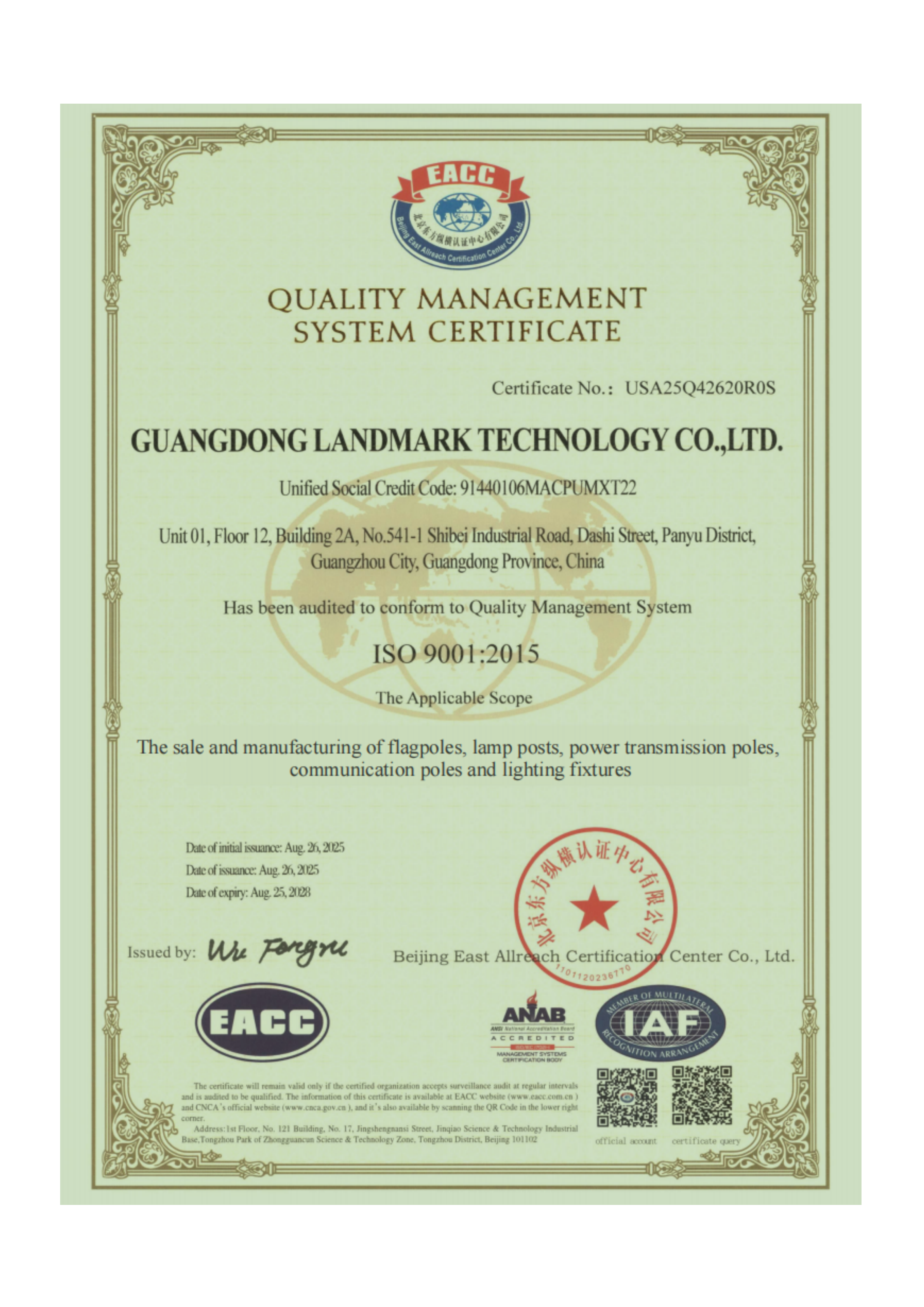
LANDMARK's public portfolio of certifications, including SGS reports and CWB welding certificates, provides transparent evidence of their commitment to international standards, facilitating approvals in markets like the UAE, USA, and Australia.
3. Engineering for Extreme Environments
This separates commodity sellers from specialists. A dedicated corrosion protection team, like Landmark's, can design solutions for the most aggressive environments—marine, oil & gas, mining—by specifying the right material (galvanized steel, aluminum, stainless steel), coating system, and protection details (sealed internal surfaces, drainage). Their expertise turns a standard street light pole into a 25+ year asset in a corrosive coastal city.
3. Success Story: A Custom Solution for a Demanding Client
A Middle Eastern municipality required solar light poles for a new coastal promenade. The challenges were significant: extreme salinity, high ambient temperatures, sandy abrasion, and a desire for a sleek, modern design. A generic supplier would have failed.
LANDMARK was selected based on their corrosion expertise and design capability. Their solution involved:
- Material: Extruded aluminium light pole bodies from alloy 6063 for inherent corrosion resistance and lightweight for easier installation on the sandy ground.
- Finish: A multi-layer powder coating system with a primer specifically formulated for chloride resistance, followed by a UV-resistant color coat, validated by salt spray testing exceeding 2000 hours.
- Design: A custom, tapered direct burial aluminium light pole design with an integrated internal conduit for the solar panel wiring, creating a clean, vandal-resistant appearance. The base was designed for the specific soil conditions.
- Integration: Pre-assembled, high-efficiency solar modules and LED fixtures were tested as a complete system before shipment.
The result was a durable, aesthetically pleasing, and maintenance-free lighting system that met the client's functional and aesthetic goals, showcasing the value of a specialized supplier.
4. Key Collaboration Points for a Successful Partnership
To ensure project success, engage with your supplier as a partner from the start.
- Define Standards and Requirements Early: Clearly communicate local building codes, wind/seismic zones, corrosion categories (e.g., ISO 12944 C5-M), and any aesthetic guidelines. Provide the supplier with all relevant project specifications.
- Request a Preliminary Design and Site Consultation: A competent supplier like LANDMARK will offer to review site conditions and provide engineered drawings, including foundation details and load calculations. This step prevents costly errors during installation.
- Clarify the Total Service Scope: Does the supplier offer full turnkey services (design, production, logistics, installation supervision)? What is the after-sales policy? For critical infrastructure, ensure spare parts availability and a clear warranty process for both structure and finish.
- Audit Quality Control Processes: Inquire about in-process inspections, weld testing methods (magnetic particle, dye penetrant), and final inspection protocols. Landmark's adherence to stringent European and American process requirements ensures quality is controlled from raw material to finished flagpole or steel light pole.
Why Consider LANDMARK as Your Specialized Partner?
With a closed-loop system covering R&D, production, and after-sales, Guangdong Landmark Technology Co., Ltd. embodies the specialized supplier profile. Their core strengths directly address the procurement criteria outlined above:
- Structural Design Expertise: In-house engineering for complex tall flagpole and high mast projects.
- Corrosion Protection Leadership: Tailored solutions for the world's most challenging environments.
- Certified Quality: A transparent suite of international certifications ensures compliance and reliability.
- Customization Innovation: A professional design team for unique decorative light pole and landmark projects.
For procurement professionals seeking a reliable, engineering-driven partner for light pole solutions, LANDMARK offers a proven track record from international sporting events to major municipal projects.
Contact LANDMARK for a consultation:
Phone: +86 13927796733 | WhatsApp: +86 18318897233
Email: sales02@landmark-innovation.com
Website: www.landmark-innovation.com
Have Questions or Need More Details?
Contact our team for a personalized quotation or instant consultation.
Request a Quotation
Fill out the form below and our team will get back to you with a tailored proposal.
WhatsApp Direct Chat
Prefer to chat in real-time? Message us on WhatsApp for instant assistance & quick answers.
- Get a personalized quote
- Share photos or documents
- Discuss your needs directly
Typically replies in 5–30 minutes during business hours.