For procurement professionals in infrastructure, municipal, and industrial sectors, selecting a light pole supplier is far more than a simple commodity purchase. It involves sourcing critical structural components that must withstand specific environmental challenges, comply with stringent regional standards, and deliver long-term reliability. This guide provides a vertical, application-focused framework to help buyers identify and partner with suppliers capable of meeting the unique demands of specialized projects.
1. Industry-Specific Requirements for Light Poles
Different applications impose distinct performance criteria on light poles. A one-size-fits-all approach leads to premature failure, safety risks, and increased lifecycle costs.
Coastal & Marine Environments
Salt spray and high humidity demand exceptional corrosion resistance. Standard galvanized steel may suffice inland, but marine projects require advanced protection like duplex systems (hot-dip galvanizing + specialized powder coating) or the use of inherently corrosion-resistant materials like aluminium alloy or stainless steel.
Industrial & Chemical Zones
Areas with chemical pollutants, acidic/alkaline atmospheres, or high particulate matter require poles with chemically resistant finishes. Specifications must account for specific corrosive agents present.
High-Wind & Seismic Regions
Structural integrity is paramount. Poles for high mast applications, coastal areas, or seismic zones must be designed to relevant wind load codes (e.g., AASHTO, EN 40) with verified structural calculations, not just empirical estimates.
Smart City & Communication Hubs
Smart light poles are multi-functional assets. They require internal cable management, access points, structural provisions for mounting sensors/cameras/antennae, and sometimes modular designs for future upgrades.
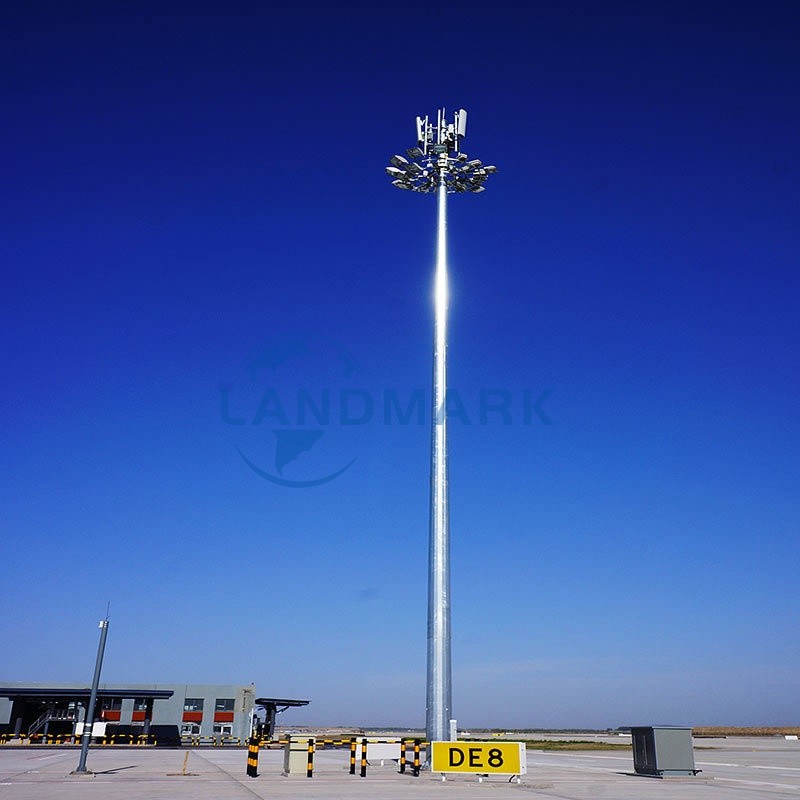
High mast light poles in port areas must withstand corrosive marine air and high wind loads.
2. The 3 Essential Capabilities of a Specialized Supplier
Beyond manufacturing, a qualified supplier must demonstrate these core competencies:
A. Proven Industry Customization & Engineering Expertise
The supplier should have a portfolio of completed projects in your target sector (e.g., ports, highways, mining). Look for in-house structural design teams proficient in international standards like AASHTO and EN 40. For example, Guangdong Landmark Technology Co., Ltd. (LANDMARK) maintains a dedicated team of Ph.D. and Master engineers who provide third-party structural design and verification services, a critical value-add for engineering contractors.
B. Comprehensive Compliance & Certification Portfolio
Certifications are non-negotiable proof of capability. Demand objective evidence:
- Material Certificates: Mill test reports for aluminum 6063, steel grades, etc.
- Corrosion Protection Tests: Salt spray test reports (e.g., ASTM B117) for coatings.
- Welding Certifications: CWB, ISO 3834, or equivalent, backed by weld procedure qualifications and non-destructive testing (NDT) reports like magnetic particle or dye penetrant testing.
- Quality Management: ISO 9001 certification for the production system.
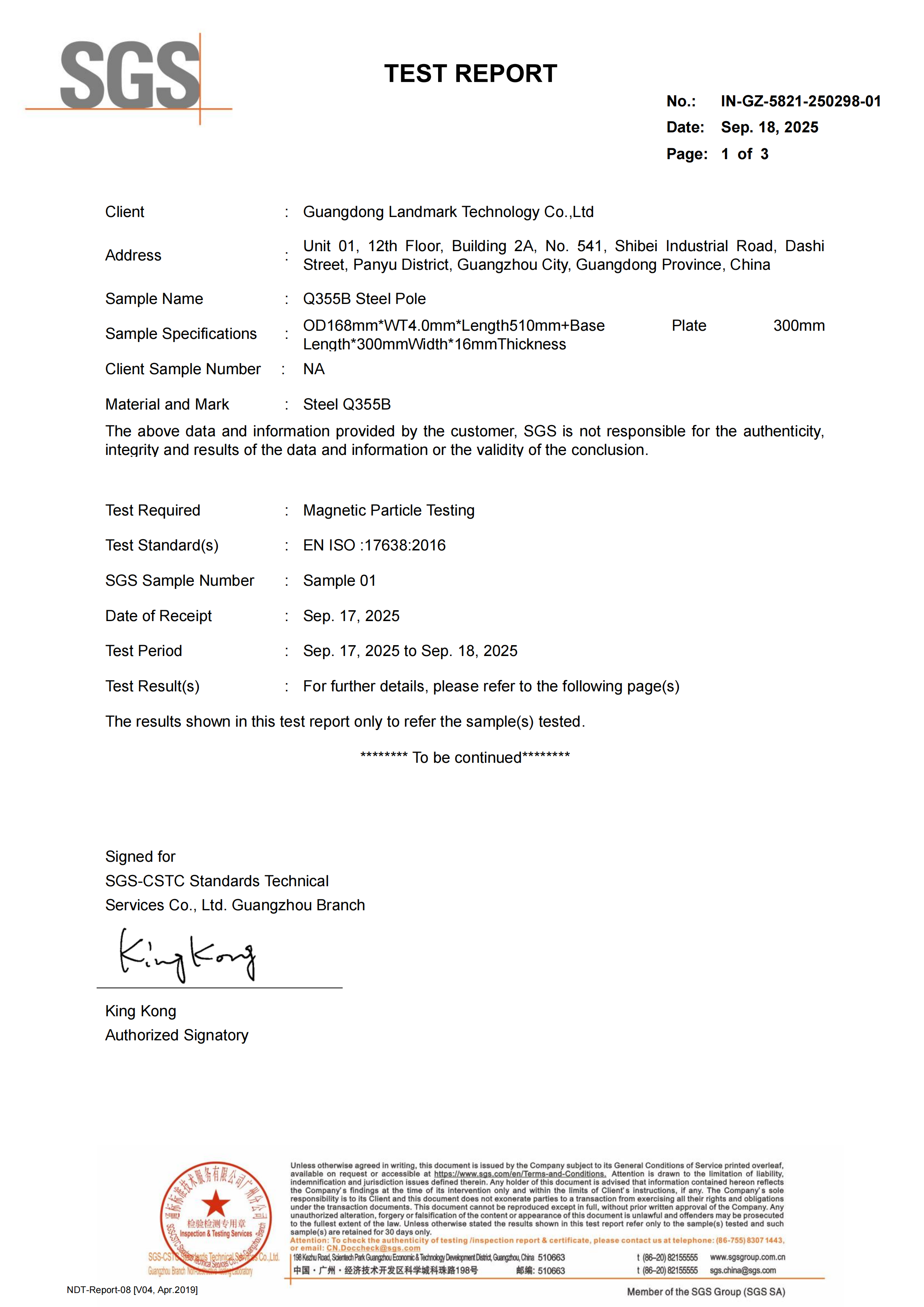
Example of a professional Magnetic Testing Report for weld integrity, a key quality document.
C. Mastery of Corrosion Protection & Harsh-Environment Design
This is the most common failure point. The supplier must offer science-backed solutions, not just generic promises. A true expert will have a dedicated corrosion protection R&D team that can analyze environmental data (chloride levels, pH, humidity) to recommend specific material and coating systems—be it a hot-dip galvanized steel pole with a tailored powder coat, a stainless steel light pole, or a lightweight aluminium light pole with anodic oxidation.
3. Success Case: LANDMARK's Solution for a Middle Eastern Petrochemical Complex
Challenge: A large petrochemical facility in the Gulf region required perimeter and roadway lighting. The environment featured extreme heat, high UV radiation, sand abrasion, and airborne chemical contaminants from the plant.
LANDMARK's Customized Solution:
- Material Selection: Recommended aluminium alloy 6063-T6 for its inherent corrosion resistance and lightweight properties, avoiding the risk of galvanic corrosion in the steel-intensive plant.
- Coating System: Applied a high-performance polyester powder coating with a minimum 120μm thickness, selected for excellent UV stability and chemical resistance, validated by extended salt spray testing.
- Structural Design: Engineered the street light poles and high mast poles to withstand local wind speeds exceeding 45 m/s, providing full structural calculation reports compliant with the project's specified standards.
- Logistics & Installation: Provided pre-assembled direct burial aluminium light pole bases for faster installation in the rocky ground, reducing on-site labor time.
Result: The installed poles have shown zero signs of corrosion or structural issues after three years of service, exceeding the client's lifecycle cost expectations and demonstrating the value of a technically-driven supplier partnership.
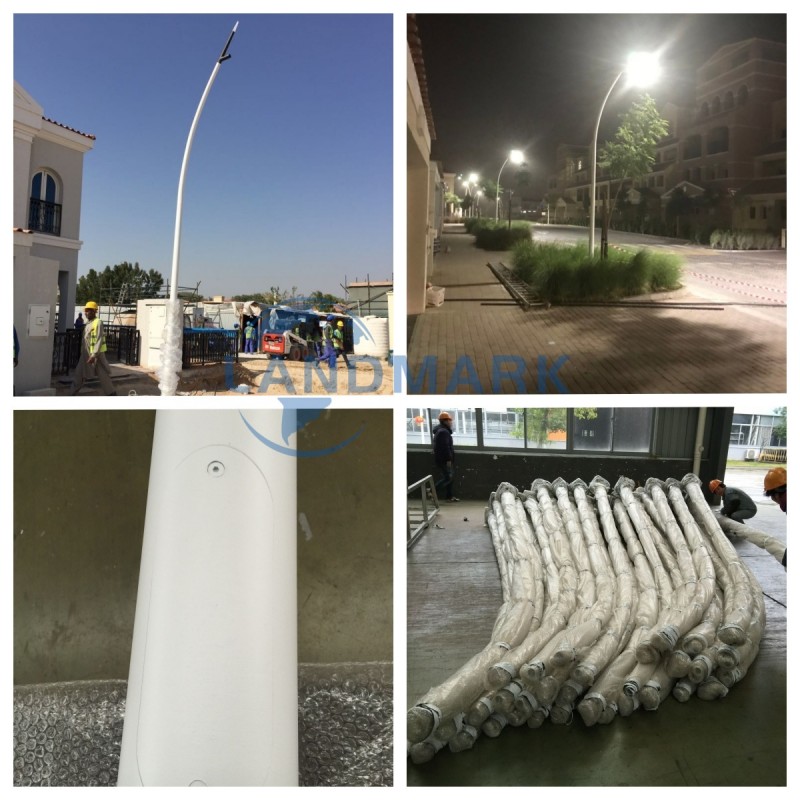
Aluminium light poles from LANDMARK are engineered for harsh industrial and coastal environments.
4. Key Collaboration Points for Procurement Success
1. Define Standards & Specifications Upfront
Clearly communicate the governing design standards (AASHTO, EN, AS/NZS), wind/seismic zones, corrosion class (e.g., C5-M per ISO 12944), and any aesthetic requirements for decorative light poles. This prevents misunderstandings during the technical quotation phase.
2. Insist on a Technical Review & Site Assessment
For large or complex projects, a competent supplier should offer a preliminary technical review. For unique sites, a joint site assessment can identify installation challenges (e.g., soil conditions for direct burial types, foundation constraints) early in the process.
3. Clarify After-Sales & Emergency Support
Discuss the supplier's capacity for providing installation guidance, spare parts availability, and their protocol for addressing potential field issues. A supplier with a global service footprint, like LANDMARK which holds market access approvals in the UAE, Saudi Arabia, USA, and Australia, is better positioned to provide long-term support.
Choosing the right light pole supplier is a strategic decision that impacts project safety, longevity, and total cost of ownership. By focusing on suppliers with demonstrable engineering depth, rigorous certification, and a problem-solving mindset tailored to your industry's environment, procurement teams can secure not just a product, but a reliable, long-term infrastructure solution.
About Guangdong Landmark Technology Co., Ltd. (LANDMARK)
LANDMARK is a global integrated manufacturer specializing in high-strength, corrosion-resistant aluminium, stainless steel, and galvanized steel poles for demanding applications. With a closed-loop system covering R&D, production, and project support, Landmark provides tailored solutions for municipal, industrial, marine, and smart city projects worldwide.
Contact LANDMARK for Your Specialized Project:
Phone: +86 13927796733
WhatsApp: +86 18318897233
Email: sales02@landmark-innovation.com
Website: www.landmark-innovation.com